Examine the parameters for your database instance:
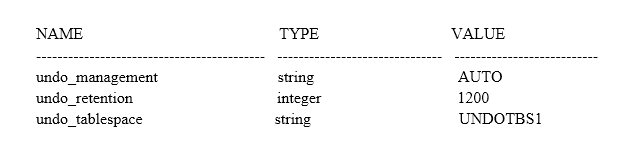
You execute the following command:
SQL> ALTER TABLESPACE undotbs1 RETENTION NOGUARANTEE;
Which statement is true in this scenario?
A.
Undo data is written to flashback logs after 1200 seconds.
B.
Inactive undo data is retained for 1200 seconds even if subsequent transactions fail due to lack of space in the undo tablespace.
C.
You can perform a Flashback Database operation only within the duration of 1200 seconds.
D.
An attempt is made to keep inactive undo for 1200 seconds but transactions may overwrite the undo before that time has elapsed.
Which two tasks can be performed on an external table? (Choose two.)
A.
partitioning the table
B.
creating an invisible index
C.
updating the table by using an update statement
D.
creating a public synonym
E.
creating a view
Examine the parameters for your database instance:
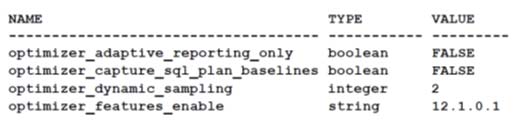
Which three statements are true about the process of automatic optimization by using cardinality feedback? (Choose three.)
A.
The optimizer automatically changes a plan during subsequent execution of a SQL statement if there is a huge difference in optimizer estimates and execution statistics.
B.
The optimizer can re optimize a query only once using cardinality feedback.
C.
The optimizer enables monitoring for cardinality feedback after the first execution of a query.
D.
The optimizer does not monitor cardinality feedback if dynamic sampling and multicolumn statistics are enabled.
E.
After the optimizer identifies a query as a re-optimization candidate, statistics collected by the collectors are submitted to the optimizer.
Which three statements are true when the listener handles connection requests to an Oracle 12c database instance with multithreaded architecture enabled In
UNIX? (Choose three.)
A.
Thread creation must be routed through a dispatcher process
B.
The local listener may spawn a now process and have that new process create a thread
C.
Each Oracle process runs an SCMN thread.
D.
Each multithreaded Oracle process has an SCMN thread.
E.
The local listener may pass the request to an existing process which in turn will create a thread.
You are connected using SQL* Plus to a multitenant container database (CDB) with SYSDBA privileges and execute the following sequence statements:
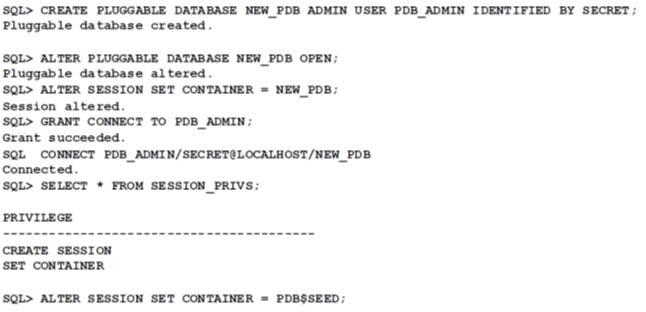
What is the result of the last SET CONTAINER statement and why is it so?
A.
It succeeds because the PDB_ADMIN user has the required privileges.
B.
It fails because common users are unable to use the SET CONTAINER statement.
C.
It fails because local users are unable to use the SET CONTAINER statement.
D.
If fails because the SET CONTAINER statement cannot be used with PDB$SEED as the target pluggable database (PDB).